
How to Check for a Warrant in Marion County
A Marion County warrant check starts with whatever paper you already have. Pull together the notice, citation, case number, the rough court date, and which agency issued it. Keep private details off commercial search sites and public screenshots. No sheriff warrant list or statewide Iowa warrant portal can answer the question by itself.
- Open Iowa Courts Online. Search by the full case or citation number when one is known. Otherwise use the name route, select Marion County, and narrow by case type.
- Read the result as a case lead. Compare county, case type, filing date, party, docket events, disposition, and any appearance entry.
- Call the Marion County Clerk of Court at 641-828-2207. Ask whether a warrant-related entry is current, served, recalled, quashed, or replaced and what action is required.
- For service, custody, or safe-surrender routing, call Marion County Sheriff dispatch at 641-828-2220 before visiting.
- For a Pella, Knoxville, or Pleasantville police record, use that city agency. For smaller sheriff-covered communities, begin with county routing.
- Request a specific existing nonconfidential record through the proper court, city, or county custodian when online access is insufficient.
Federal matters follow a different track. The Southern District of Iowa and PACER handle them, and Iowa Courts Online will not search federal warrants touching Marion County.
Marion County Court Search Fields
Iowa Courts Online gives the public two main ways in. A full case or citation number works best, since it cuts down namesake mistakes. With only a name, add more characters and study every identifying detail before calling the Marion County Clerk. The first match is not always yours.
| Search route | Fields | Best use |
|---|---|---|
| By Name | Case type, county, first name, last name, or partial citation | Finding a possible Marion County case when no identifier is known |
| By Case or Citation | Case type, county, case ID, or citation number | Matching a known court paper with the full identifier |
| Clerk confirmation | Case number, citation, date, county, and precise question | Learning the official current docket status |
| Sheriff routing | Known case and issuing agency details | Service, arrest processing, custody, or safe contact |
The official help material is blunt: online information is not the official court record. A new citation can take roughly two to three weeks to appear. A blank result does not prove that no Marion County warrant exists.
Types of Warrants in Marion County
Iowa labels describe what the court order does and why it arose. What counts is the label on the live docket. Marion County court staff can tell you whether an entry is a warrant, a summons, or a missed-appearance event.
| Type | How it arises | Issuing route |
|---|---|---|
| Arrest warrant | Authorized criminal process supported by the required legal basis | Judge or magistrate in Iowa District Court |
| Bench warrant | Common phrase for arrest process tied to missed court or noncompliance | Judge or magistrate handling the case |
| Failure-to-appear warrant | A required appearance or step is missed under applicable procedure | The court with the underlying case |
| Traffic-related warrant | A traffic case reaches a missed-duty stage and the court orders arrest | District court or magistrate process |
| Search warrant | Authorizes a search for specified evidence, not a person’s arrest | Authorized judicial officer under Chapter 808 |
Iowa has no Texas-style public capias-pro-fine portal. The safe Marion County phrasing is "bench warrant" or "arrest warrant for failure to appear," confirmed with the Clerk. A traffic citation, a late fine, a summons, and a warrant are separate records.
No Marion County Warrant Roster
The sheriff posts no Marion County active-warrant search, no downloadable outstanding-warrant file, and no most-wanted roster. What the office does publish is a Recent Arrests route through "Who's in Jail?" plus a Sheriff's Office Metrics page, and both describe arrests, custody, or operations rather than every unserved warrant. The official "Who's in Jail?" landing page shows what the county labels as its recent-arrest tool.
That county page helps with custody context, but it is not a Marion County warrant roster.
Practical fallback: Search the public case docket, confirm the entry with the Clerk, then ask sheriff dispatch about service or custody.
An empty dashboard cannot clear a warrant, and current custody does not reveal every open court order. Skip third-party lists that may be stale, copied, or stripped of case context in Marion County.
What a Marion County Warrant Record Shows
One Marion County case can split into several parts: the signed warrant, the public docket, the charging record, the officer return, and the bond order. The online view may show only some of them. Use the case number to tie entries together. Ask the Clerk which record controls the case now.
| County and court | Marion County and Iowa District Court identify the local judicial file. |
|---|---|
| Case identifier | A court case or citation number, illustrated only as FECR-012345. |
| Named party | The person identified in the case; compare details carefully to avoid a namesake. |
| Offense or citation | The alleged charge, classification, or traffic matter, not proof of guilt. |
| Issue and signature | Date, command to peace officers, and judicial authorization when disclosed. |
| Bond entry | An endorsement or later condition that may require a judicial officer. |
| Status and return | Service, appearance, recall, quash, return, or another later docket event. |
Form 6 is Iowa's blank arrest-warrant template, showing the fields common after an indictment or information. It is not a live warrant. A docket entry hinting at failure to appear also cannot establish that an executable Marion County warrant is still open.
Marion County Court Data Limits
Iowa Courts Online is a public case-search and payment tool, not a certified live warrant database. Its name and case-number modes can pull up a Marion County docket, though protected data may be left out. Treat results as leads, then put a precise question to the Clerk. Namesakes cause plenty of errors, so match Marion County, the case type, the filing date, the citation or case number, and the agency you know. If a new citation has not posted yet, allow for the documented delay but do not ignore the date on the paper. When a deadline is close, call the Clerk rather than waiting on the screen.
- Active
- A current status that must be confirmed by the court or enforcing agency.
- Served
- The warrant was executed and returned through authorized process.
- Recall
- The issuing court withdrew the warrant.
- Quash
- The court set aside the warrant or process.
- Failure to appear
- A missed required court step that may lead to arrest process.
None of these terms equals dismissal, conviction, payment, or release. Ask the Clerk what the Marion County docket entry means in your specific case.
Who Issues and Serves Marion County Warrants
Judicial process in Marion County comes from the Iowa District Court, Judicial District 5, and its magistrates. Magistrates sit within the district-court structure. They may hear simple misdemeanors, traffic cases, city or county ordinance matters, municipal or county infractions, and preliminary proceedings, and they may issue warrants or arrest orders within that authority. The Marion County Clerk of Court keeps the local court file, while the sheriff handles service, custody, and law-enforcement routing for the county and unincorporated areas. Pella, Knoxville, and Pleasantville police handle city agency matters. Federal warrants belong to the Southern District of Iowa and its enforcement channels.
Marion County Clerk of Court
214 E Main Street
Knoxville, IA 50138
641-828-2207
countyclerk.marion@iowacourts.gov
Marion County Sheriff’s Office
211 N Godfrey Lane
Knoxville, IA 50138
641-828-2220
General weekday office hours are published, but the sheriff runs no dedicated warrant desk or surrender window. Call ahead before you travel in Marion County.
Marion County Sheriff Contact Routes
The sheriff's page splits its contacts by purpose. Dispatch and records run through 641-828-2220. Jail questions go to 641-828-2245, and the Civil Division uses 641-828-2247, though civil service is not an arrest-warrant lookup line. The official sheriff contact source displays the Marion County Law Enforcement Center and its published phone routes.
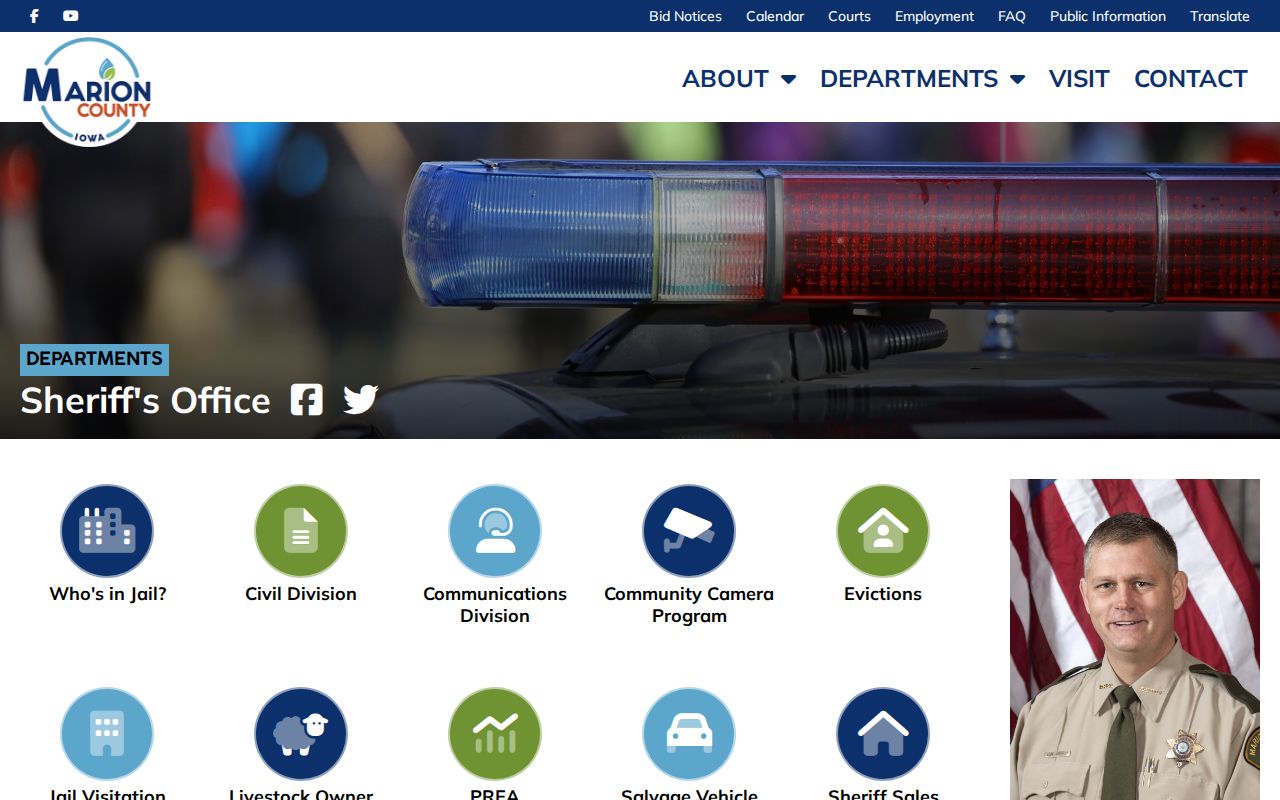
Call before you go. The Marion County sheriff's contact page backs that habit, since it never promises a warrant counter, a payment desk, or a surrender service. General office hours run Monday through Friday, 8:00 a.m. to 4:30 p.m., with lunch coverage, and those hours say nothing about warrant service. Dispatch can route a call. Dispatch is not the district-court records custodian, though. For docket meaning, certified copies, payments, or what appearance the court requires, the Clerk is the better contact.
What to Do If You Have a Marion County Warrant
Start with the court and the case number. Confirm with the Clerk that the entry is still current, and ask what the Iowa District Court requires next. The fix could be a new date, a payment plan, a required appearance, an attorney motion, a recall, a quash, a surrender, or bond. No single option fits every Marion County warrant.
- Give the Clerk the case or citation number and ask for current status.
- Ask whether an appearance is mandatory and whether counsel may arrange a motion, court date, or surrender plan.
- If law-enforcement contact is required, call sheriff dispatch before going to the Law Enforcement Center.
- Ask the authorized court or jail office for the exact bond or payment procedure and accepted instruments.
- Keep all receipts and release conditions, confirm the next date, and continue the underlying case.
Act promptly: A confirmed warrant can lead to arrest during later law-enforcement contact; consult a licensed Iowa attorney and follow official instructions.
Marion County runs no amnesty event, no guaranteed walk-through, no online warrant-bond portal, and no recall form. No office publishes a warrant-only walk-in schedule either. Paying a fine or posting bond does not itself resolve the charge or prove a recall.
Marion County Bond Is Case-Specific
When court is not in session, the Iowa Judicial Branch publishes a uniform bond schedule for certain arrests. Treat its categories as general rules, not a quote for your Marion County warrant. Some charges require a judicial officer before any bond is set. Case conditions and judicial discretion can also change the outcome, so the schedule alone settles nothing.
Cash bond, surety bond, and personal-recognizance release work differently. The county publishes no bondsman directory, no universal payment-method list, and no online warrant-bond system. Ask the authorized court or jail office about the amount, the accepted instrument, the receipt, the release terms, and forfeiture rules. The jail contact is 641-828-2245.
Online fine payment is separate from bond. The Judicial Branch payment page warns that paying online is generally a guilty plea unless an appearance is required. Confirm the case and its legal effect first. Keep the receipt, and ask the Clerk whether any court step still remains.
Public Access to Marion County Warrant Records
Iowa Code Chapter 22 is the state's open-records framework. It covers existing public records, fees, access, enforcement, and confidentiality exceptions. It does not force an agency to build a Marion County warrant database, and it does not open sealed court or investigative material. Court rules and other statutes govern district-court records too.
Access boundaries: Iowa Code Chapter 22 permits specific requests, while Iowa Code section 804.29 protects information filed to secure an arrest warrant until the statutory disclosure point. Chapter 232 supplies separate juvenile confidentiality rules.
A county records request can start at the Marion County Public Information page or with the sheriff records custodian. State court records go through the Clerk and the Judicial Branch. Name the agency, the record type, the case number if known, the date range, the fields you want, and your preferred format. Fees may cover copies, postage, retrieval, review, redaction, supervision, or programming where authorized. A withholding or redaction does not prove no warrant exists. Ask for the legal basis when it matters. Then lean on the Clerk or an attorney for next steps in Marion County.
Marion County Warrant Confidentiality
Under Iowa Code section 804.29, information filed to secure an arrest warrant can stay confidential until arrest and return or initial appearance. That rule explains why an affidavit, order, or supporting fact may be missing from a public docket the moment you search. Other material may also be withheld or redacted: protected juvenile files, confidential informant information, victim details, medical facts, personal identifiers, and safety-sensitive investigative records. Public access is not unlimited access. A narrow request for nonconfidential fields serves you better than a demand for every warrant and every person.
Iowa DPS runs the IOWA System, which holds warrants, missing-person records, protective orders, and other justice data for authorized agencies. The official IOWA System description offers no public search form. Do not ask for criminal-justice network access. Public users have better routes: Iowa Courts Online, the Clerk, the correct agency, and a focused public-record request in Marion County.
Warrant Records by City in Marion County
The five city profiles here follow 2020 Census population order. Each city lists its own contacts, but district-court cases still run through the Marion County Clerk. None of the five publishes a public city warrant list or a stand-alone municipal-court warrant portal.
Pella Warrant Records
Pella Police has official report and resources channels, but its public portal is not identified as a warrant search. Court cases route to the Clerk.
Knoxville Warrant Records
Knoxville Police, the county courthouse, and the Law Enforcement Center are separate offices with different record roles.
Pleasantville Warrant Records
Pleasantville city hall and police have different phone numbers. Its code is not a live court docket.
Melcher-Dallas Warrant Records
City code categories help identify the matter, while court status belongs with the Clerk. Verify current city contacts before visiting.
Bussey Warrant Records
The sheriff names Bussey within county coverage. No separate public police or municipal-warrant portal was found.
A city name on a paper tells you where the matter started. It does not tell you which office holds the record now. In Marion County, ask whether the item is a parking matter, a municipal infraction, a state citation, a police report, or a district-court case.
Marion County City and Court Boundaries
Pella, Knoxville, and Pleasantville each have municipal police contacts. Melcher-Dallas and Bussey use different city or county routes. One caution: a police report is an agency record, a city code is a legal text, a court docket is a judicial record, and a jail entry concerns custody. None of them can stand in for the others.
The addresses matter when you are holding a citation. Pella Police sits at 614 Main Street, while Pella City Hall is at 825 Broadway. Knoxville keeps its courthouse, Law Enforcement Center, and police office at separate locations. Pleasantville uses one phone number for city hall and another for police.
Bussey leans on sheriff coverage plus Clerk confirmation. For a Melcher-Dallas city notice, ask the current city office whether it holds a municipal record or whether the matter went to district court. Across all five Marion County cities, a missing local portal just means the record sits with a custodian. It does not mean no record exists.
Marion County Warrant Scam Checks
Scammers have been busy in Marion County. Iowa courts warned in 2026 about calls, texts, and mail that demand money for warrants, fines, or jury duty. Real courts never ask for prepaid cards, Bitcoin, or a Social Security number to clear a matter. Pressure to pay on the spot is your cue to hang up. Before sending anything, verify. Use a phone number pulled from an official government source, never the one the caller gives you. Check the case through Iowa Courts Online or the Marion County Clerk. The state payment help line is 515-348-4788 during published weekday hours. If the message threatens immediate arrest or demands secret payment, keep it and contact the proper law-enforcement agency. A genuine court obligation still deserves prompt attention. But urgency is no excuse to skip verification. No private service can recall a Marion County warrant, and only the issuing court can quash one or confirm the current record.